August 30, 2007

The Road to Mandalay Part 5: Mandalay


:: The Final journey on the Road to Mandalay ::


I genuinely thought that the mystic "Road to Mandalay" line originated from the nursery rhyme where Nellie the elephant and the head of the herd "met one night in the silver light on the road to Mandalay". It's since emerged (after a couple of days of me humming the song) that Australians don't have that nursery rhyme and it was actually Rudyard Kipling who coined the line in his poem "Mandalay".

Anyhow we can vouch that the road to Mandalay is in dire need of resurfacing but it does get better the closer you get to Mandalay. One thing we forgot to mention before was that as a former British colony, Myanmar traffic drove on the left side of the road until 1970 when the military administration suddenly decreed that traffic would now drive on the on the right side of the road. However, there are still many old cars and buses and almost all the modern cars are second hand imports from Japan so virtually every vehicle is right hand drive. This creates a dilemma that requires someone literally hanging out the passenger window or bus door watching the road ahead informing the driver (whose view is completely blocked) on whether or not it's safe to overtake.

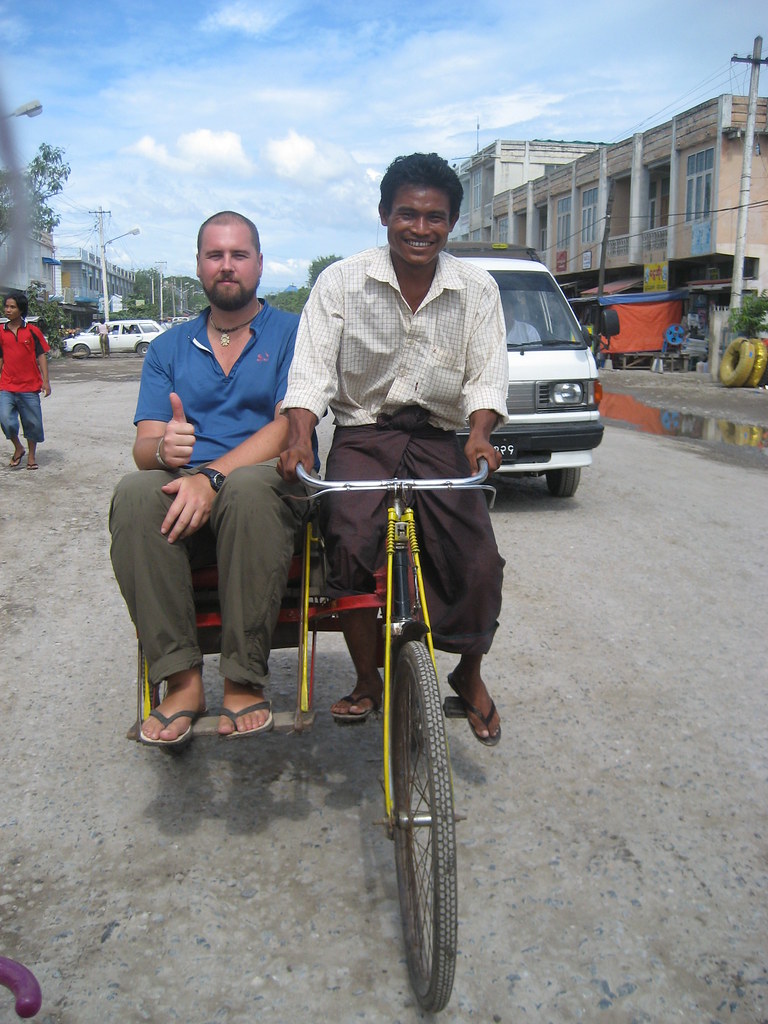
Hours later we pulled into Mandalay bus station, located a totally inconvenient 7 miles from Mandalay city centre. As expected we were quickly surrounded by taxi touts looking for our business and the haggling for the correct fare for the journey began. Suddenly as the price for the taxis was becoming reasonable two guys appeared out of left field to bid for the job only difference was that they were trishaw drivers. After explaining that we couldn't have them cycle us and our bags 7 miles into the city they protested telling us that they were having a slow day and needed the business .... and besides they did it all the time. And so the final 7 miles of the road to Mandalay was tackled at a leisurely pace right down the middle of a dual carriageway full of huge trucks, buses and taxis.
We got chatting to our riders...in between lung fulls of exhaust....and they provided us an interesting insight into their business. It turned out that these guys were trishaw drivers by choice, they had an education, had good English skills and had work experience but with the current state of things they earned more riding than they did teaching or working for the government. To rent their bike cost them 300 KYT per day (~.30c AUD). Their goal was to save and buy the bike (100USD) , which one of the guys recently had achieved. Rent is 4000KYT (4$ AUD) a month for a bamboo hut. These guys worked hard, but with their language skills they were well placed to get work from tourists which hopefully means more income for them.


Our first impressions of Mandalay can be summed up by the words hot and dusty. It's a relatively new city, only 200 years old, identifiable by it's modern grid streets numbered New York city style. From the number of Chinese hotels and businesses it's very apparent how important Mandalay is as a city on the main road to China. Undoubtedly it will continue to grow as the Chinese investment pours in. Around the centre of town each street corner is multifunctional acting as a trishaw rider station, a bike repair area and a couple of business who time share the space, i.e. a tool shop by day and street restaurant by night.
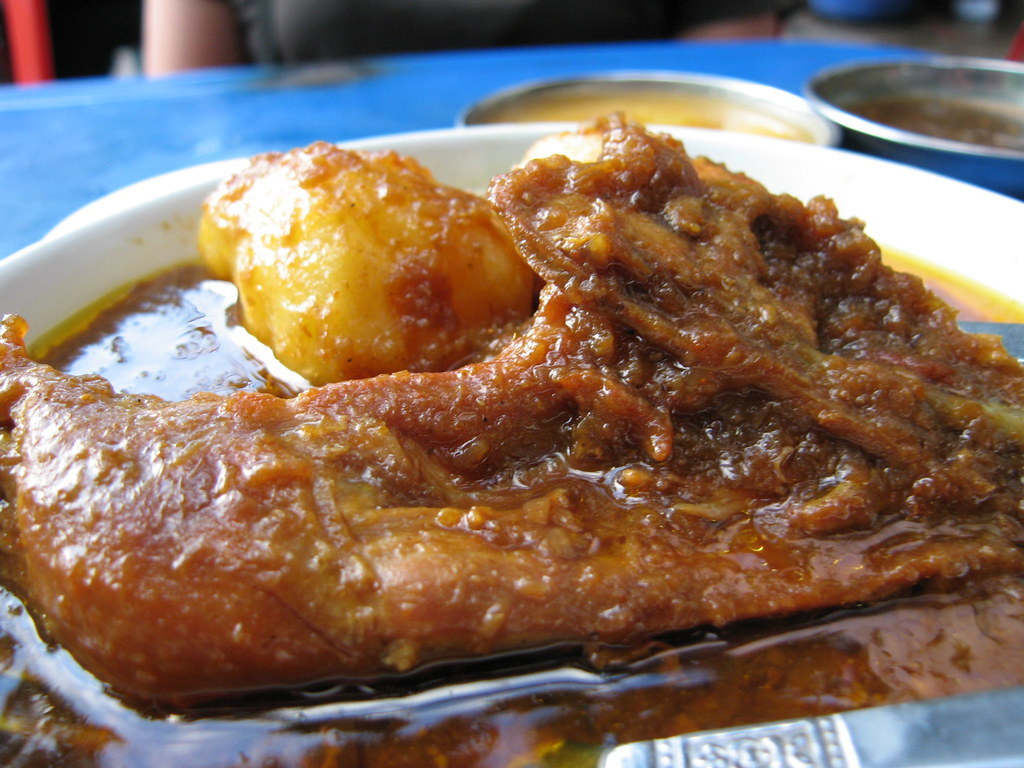

:: Chicken Curry ::


After a day or so we had identified Chapatti Corner, one such street restaurant cooking up out of this world curries and serving up piping hot chapattis. It was to be the first of many of our visits to that particular street corner. Every evening at 4pm a shop closed and the pavement converted into a full on busy restaurant serving hundreds of diners from 5pm onwards.


:: Fermented tea Leaf Salad ::


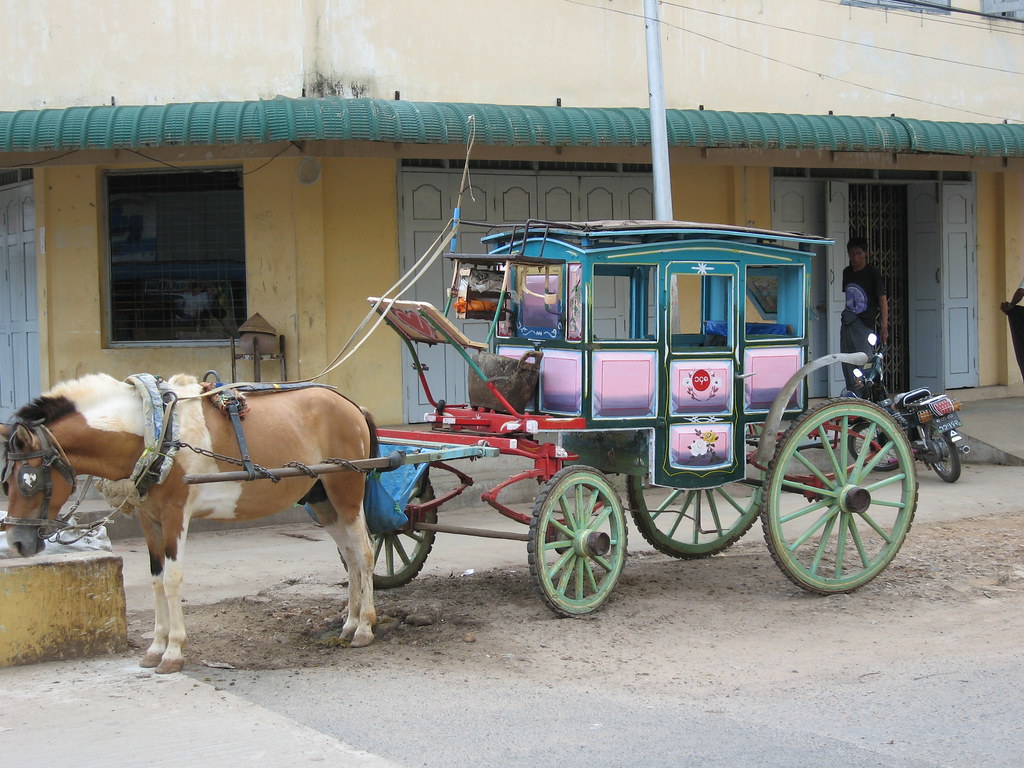
To escape the heat of Mandalay we took a side trip to the hill town of Pyin OO Lwin three hours pickup drive away. This is a charming little town with many imposing colonial buildings and a colourful fleet of horse drawn stagecoaches that provide a taxi service around town. It's like the wild west meeting the cool Mandalay hills. The highlight of our trip up there was finding a great tea shop with an amazing tea leaf salad and crispy naan bread.


:: Local Cabs ... ::

With our trip to Myanmar finally coming an end we had enough time for one more meal at Chapatti corner, one more draft Myanmar, some last minute souvenir buying and one last ice cream from Nylon Bar before heading for Mandalay airport for our flight to Kunming, China.
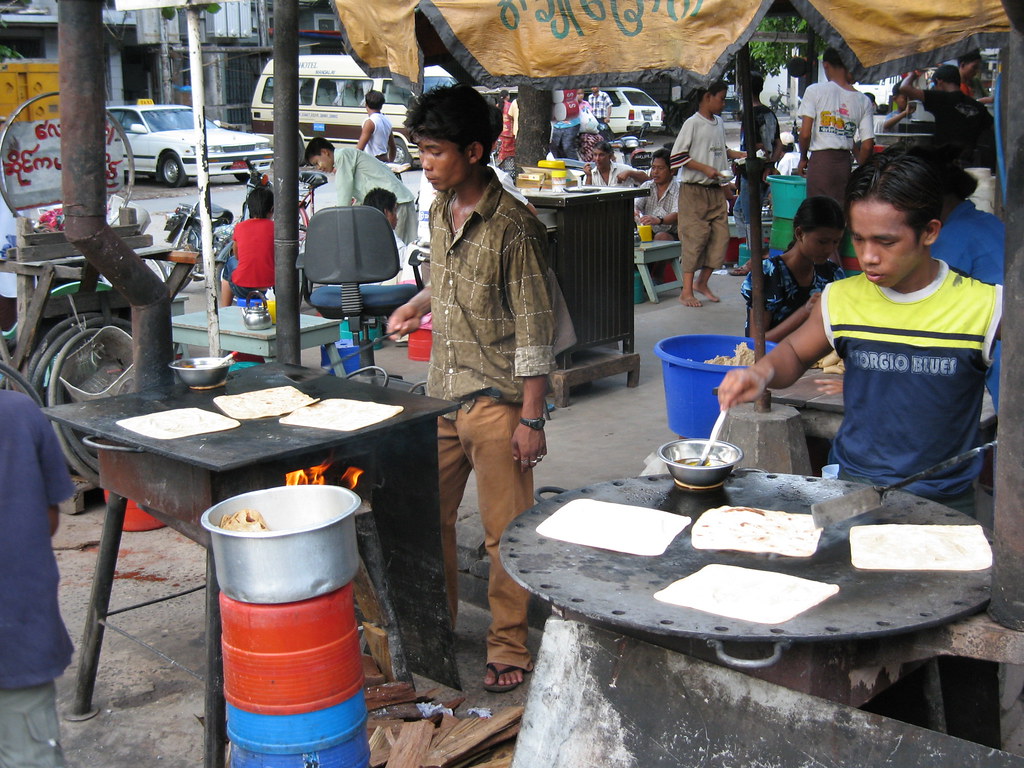


:: Chappati Corner ::


Read Full Post...

August 14, 2007

The Road to Mandalay Part 4 : Bagan


There are two preeminent ancient religious cities and archaeological sites in South East Asia, one is Angkor Wat in Cambodia and the second lesser known one is Bagan in Myanmar. The unpopularity of Myanmar as a tourist destination has meant that Bagan's vast array of temples have been relatively unvisited in comparison to it's counterpart city Angkor. The LP sums it up quite well saying 'Imagine all the medieval Churches of Europe, built in an area the size of Manhatten island'.

Bagan entered the golden age in 1057 AD when King Anawrahta conquered the Mon capital of Thaton, and brought back to his capital the Tripitaka Pali scriptures, a large number of Buddhist monks and artists and craftsmen of every description. The result was the transformation of Bagan into a religious and cultural centre. In the 12th and 13th centuries, Bagan became a truly cosmopolitan centre of Buddhist studies, attracting monks and students from as far as India, Sri Lanka as well as the Thai and Khmer kingdoms. It was during these two centuries of extraordinary architectural and artistic activity that city and its surrounds were covered with over 13,000 splendid monuments of every shape and size, the inner walls of most of which are decorated with incredible frescoes.

Today some 2,224 monuments from the original 4,446 that existed at the end of the 13th century still stand in a vast open plain covering 16 square miles. From the top of most of the temples you can look out across the dusty plain and see and endless uninterrupted view of literally thousands of temples.


Bagan is divided into three sections, Old Bagan where the ruins are co-located with a couple of swanky hotels, New Bagan where all the locals were "relocated" to by the government in 1990 (from Old Bagan) and Nyuang-U where most of the tourists hang out and every second restaurant offers "pizza and pasta". Staying in Nyuang-U you quickly find out there are two ways to see the temples; you can hire a horse and cart or take a bicycle, we chose the route of most independence and found ourselves on a three day very hot bike expedition around miles of sandy paths that meander around the thousands of temples. There are so many temples that it's impossible to see all of them all. Our route didn't always go to plan and there was lots of pushing the bikes through ploughed fields to a pagoda where we couldn't find the road. Our most annoying experience was where the map indicated that there was a road straight through a golf course and out the other side but a security guy on the gate refused to let us cycle through whilst droves of locals were whizzing along the route. Yes.... I did say golf course... there are even a couple of stupas in the middle of it all... there wasn't a sniff of a golfer the day we didn't pass through.


There are some highlight pagodas which see the most tourists every day. You can easily tell how popular a place is by looking to see how many hawkers are selling laquerware and sand paintings outside. We preferred some off the beaten track temples where we could usually get a few minutes of solitude up the top admiring the view before we were tracked down by someone selling their wares. Unfortunately there are a large number of really young kids selling post cards and trying to collect and exchange foreign currency from tourists. The hassling around the area is very persistent and can become very annoying. The Burmese phrases "I'm not buying" and "I don't want" came in very handy when they didn't fall on deaf ears.


Entrance into the archaeological area is totally unrestricted, foreigners purchase their $10 US dollar entrance ticket at the airport or on the bus on the way to Bagan this then entitles you to unlimited access for an unlimited amount of days to the area. It's largely accepted that most of the entrance fee lines the governments coffers with only a small portion actually going to the preservation and protection of the Bagan area. Sadly UNESO failed to designate Bagan has a world heritage site and has pulled out of the country after allegedly finding it impossible to work with the Myanmar government. It's also reported that the military junta has haphazardly restored ancient stupas, temples and buildings, ignoring original architectural styles and using modern materials that bear no resemblance to the original designs. Interestingly The Plain of Bagan is a living collection, new stupas are being built by rich families, this is a really great thing, its a growing spectacle.
Due to the lovely Chinese Internet Blocking policies I Cant embed this video in the post. The link below should work. Its a Panorama of the Bagan Plain.


Read Full Post...

August 13, 2007

The Road to Mandalay Part 3 : Kalaw


:: Almost Full..... ::


Leaving Inle behind we jumped in a local pickup truck, waited for it to fill up with other tourists and locals, and when full ....we squeezed in more people and trundled off at snails pace. Somehow our antique vehicles exhaust managed to belch all the exhaust fumes into the passenger area. During the first 5 minutes of the journey there was lots of talk between all the western tourists. After about 20 minutes an overwhelming feeling of tiredness kicked in, total silence prevailed as the carbon monoxide headaches developed. Eventually we reached the Shwenyaung junction where we took a few deep breaths and found another pickup going to our destination of Kalaw high up in the hills. Another hour down the road and we were shunted into yet another pickup truck that took us the scenic route via the a local market where it dropped off some cargo, we hand delivered letters to some business and collected and delivered a 44 gallon drum of petrol before continuing on to our destination.


:: The Old & The New - Paulong Manuscripts ::

Kalaw was a popular cool destination for British to escape the heat of other areas in Burma during colonial times. Nowadays it's slowly turning into a backpacker town and base for trekking - lots of tourists hike from Kalaw to Inle lake on a 3 day 2 night outing. We missed the boat on that one so settled for a one day hike up into some of the local villages around Kalaw. Unfortunately we chose the worst day and ended up drenched and literally up to our knees in mud. Despite the mud we'd a great day, our guide answered numerous of our questions about Myanmar stretching to "has Myanmar ever won a medal at the Olympics?"


:: Our Host & Paulong Writer ::

After a few hours hiking through the tea and orange tree plantations we stopped for lunch in a house of a local village man for lunch. Our host was bent over a manuscript carefully transcribing lines from an old text for the local monastery, he is regularly commissioned to reproduce texts of the story of his tribe. He is the (only) writer in the Paulong village. He passed on the skills of writing the Paulong language to his son who is now a monk in the village. The book he was transcribing was of Buddhas life, from a copy he wrote a number of years ago. Traditionally the books are made from a large number of paper sheets glued together. The ink is made from tea leaves ... mix it with the pigs gallbladder. It was a few hours of slipping and sliding in the mud later when we dropped back into Kalaw town. After a couple of refreshing Myanmar Beers we trudged back to the guesthouse for welcome hot shower.


:: Flooded Rice Paddies around Kalaw ::

An early 7am start the following morning saw us rushing out of the guest house (a soft boiled egg in hand for breakfast) to wait on the side of the main road for the Bagan bus to pass through somewhere between 6:45am and 8am. When it arrived the bus was already pretty full i.e. all the seats in the aisle had bums on them and so we'd to negotiate ourselves into our seat assignment which luckily happened to be the only two seats available. Three hours later we all got a breath of fresh air when the bus emptied out to watch the bus helpers change a flat tyre. We were very fortunate and managed to go until 3.30pm that afternoon before we experienced our second puncture which auspiciously occurred within spitting distance of a puncture repair outfit. As darkness fell we finally arrived in Bagan and began the accommodation search - enviously passing restaurant after restaurant of tourists tucking into dinner and frosty beers.


:: It really was muddy ::


Read Full Post...

  © Blogger templates The Professional Template by Ourblogtemplates.com 2008

Back to TOP